

ELLITE PADEL perimeter lighting vs traditional floodlights
Padel lighting – legal regulations
Are there differences in photometric distributions? Have I been installed lighting that complies with FIP regulations?
- Target: 1,000 lux – Uniformity Em 0.86 with 4,000 K (4K – TV – Streaming)
- REAL consumption: 1,860 W (including power supply efficiency)
- Performance – Lm/W – According to ILIAC – ENAC laboratory
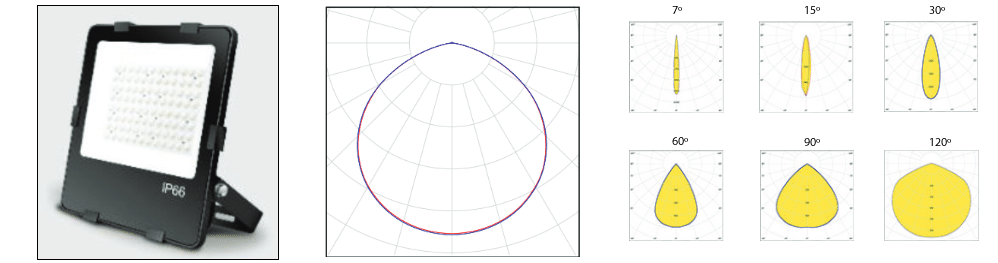
Differences between lenses or photometric distribution
Floodlights and legal regulations: FIP / EU / UK / USA
A large proportion of the floodlights installed on padel courts do not have lenses, or do not have the correct lenses for sports activities.
The light distribution is therefore determined by the beam angle of the diodes. 90% of diodes have a 120° beam angle, with no primary or secondary lens.
Una apertura de 120º ( tal como se ve en el diagrama), está proyectando con forma de esfera, abriendo a la derecha-izquierda / arriba y abajo por igual.
An important part of the light is projected onto the ceiling or the space, which results in the following disadvantages:
- We fail to comply with the regulations National and European
- The light distribution therefore depends on the beam angle of the diodes. 90% of diodes have a 120° beam angle, with no primary or secondary lens.
- We cause glare By increasing the power => UGR 80
- We concentrate a lot of light in very small spaces.
- La Light creates large shadows Flat shadows of all elements.
- We generate a lot Visual fatigue, with the consequent Risk to health Associated
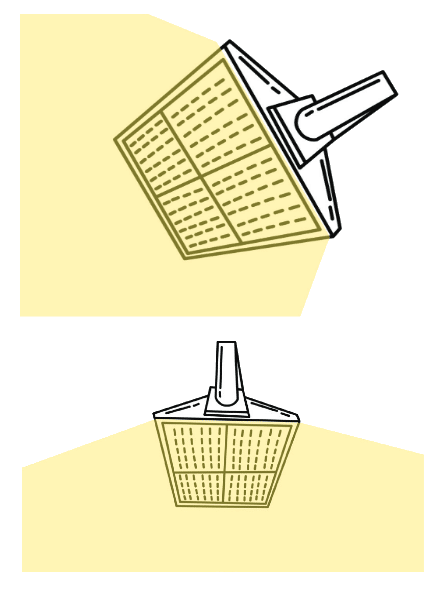
- Any lighting system must be aimed towards the ground. If we draw an imaginary “horizon” line at the height where the luminaire is installed, 99% of the light generated must be directed towards the ground.
- Tout système d’éclairage doit être orienté vers le sol. Si l’on trace une ligne imaginaire « horizon » à la hauteur où le luminaire est installé, 99 % de la lumière générée doit être dirigée vers le sol.
- Tout système d’éclairage doit être orienté vers le sol. Si l’on trace une ligne imaginaire « horizon » à la hauteur où le luminaire est installé, 99 % de la lumière générée doit être dirigée vers le sol.
- A low-cost supermarket car park floodlight is not suitable for lighting padel courts.
- They are extremely inefficient, highly harmful to players’ vision, and generate very high and outdated light pollution, plus invasive light from court to court, intrusive light affecting nearby homes, and visual fatigue for players.
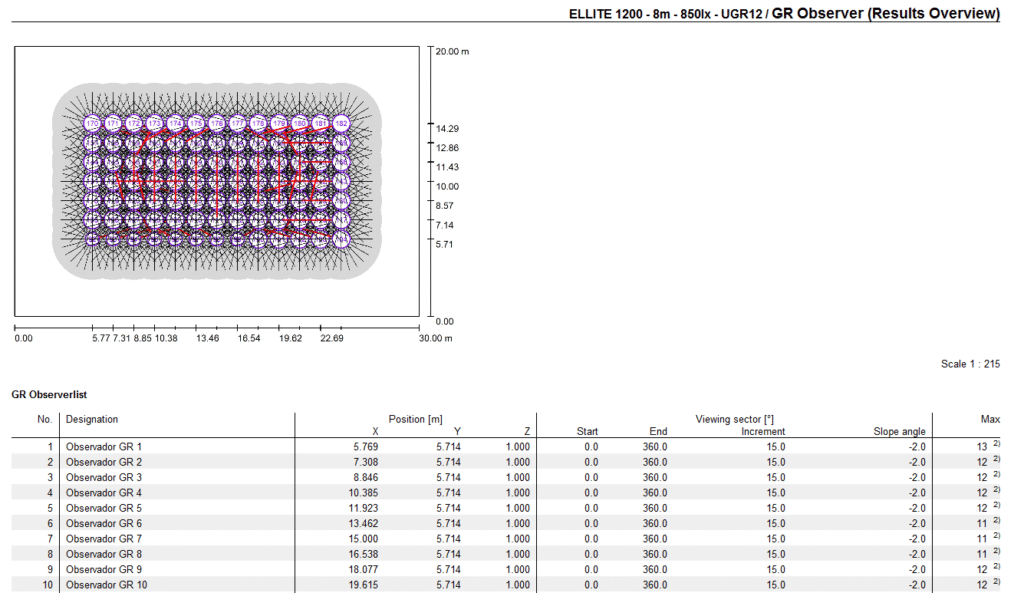
UGR 12 glare – ELLITE 1200 luminaire – 8 m height – 850 lx – PREMIER PADEL
- Highest measured point value: 13
- Lowest measured point value: 11
- According to regulations, we are at insignificant levels.
- Considering that this is 850 lux for live TV broadcast
Playing padel requires a great deal of precision. The ball moves very fast, and there is the added challenge of using transparent glass or metal mesh as walls. Constant high-speed rallies demand the very best lighting — ensuring GREAT PRECISION WITH NO GLARE AND NO SHADOWS.
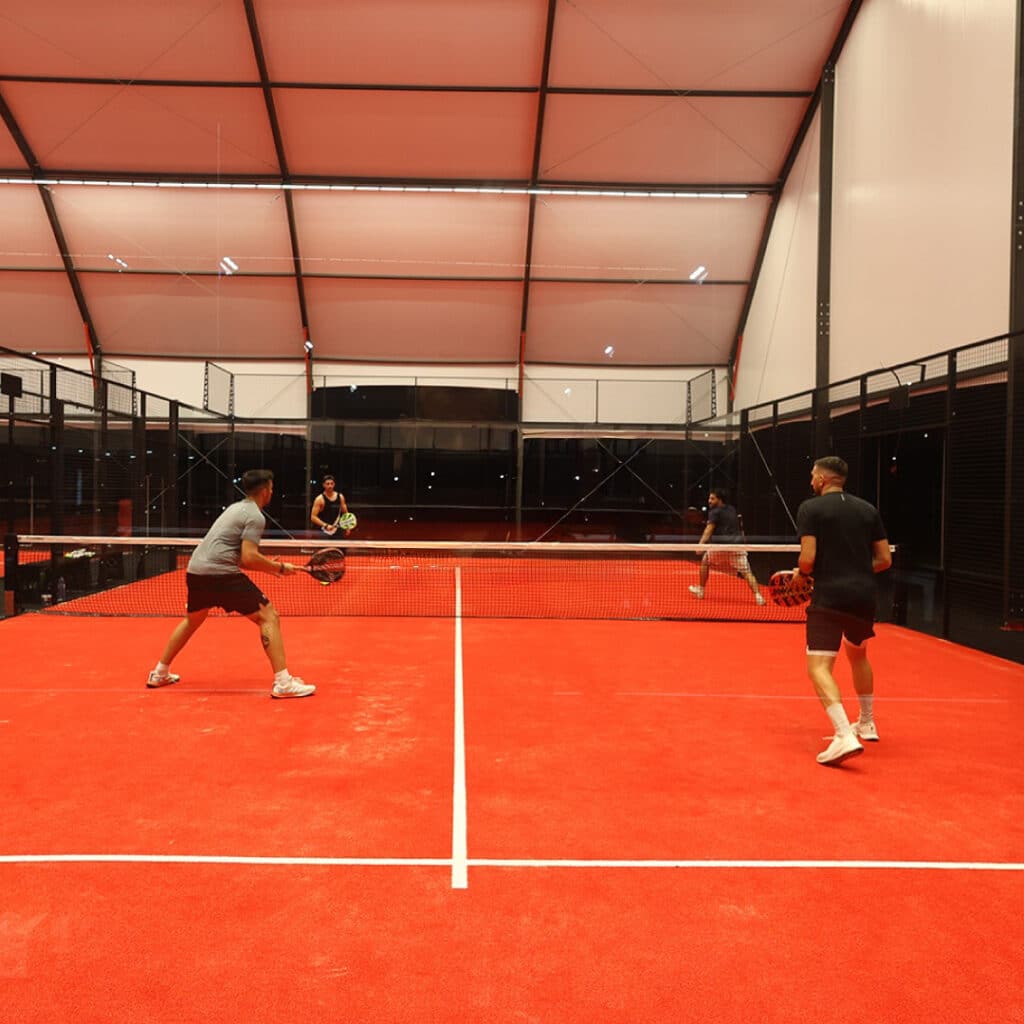
How to choose the ideal lighting to protect padel players’ visual health?
Artificial lighting is an element present in virtually every place we are. Therefore, when choosing the lights we are going to use, we must take various factors into account, including players’ comfort and visual health.
The parameter that helps us determine whether a light is comfortable to use or not is the Unified Glare Rating (UGR).
Padel is a sport that requires a high level of precision. High-speed movement, sudden turns, constant movement around the court and lobs are all part of the game. When players look up, traditional floodlights cause glare and visual discomfort.
How UGR improves visual comfort in padel
UGR: the key parameter to prevent glare in padel
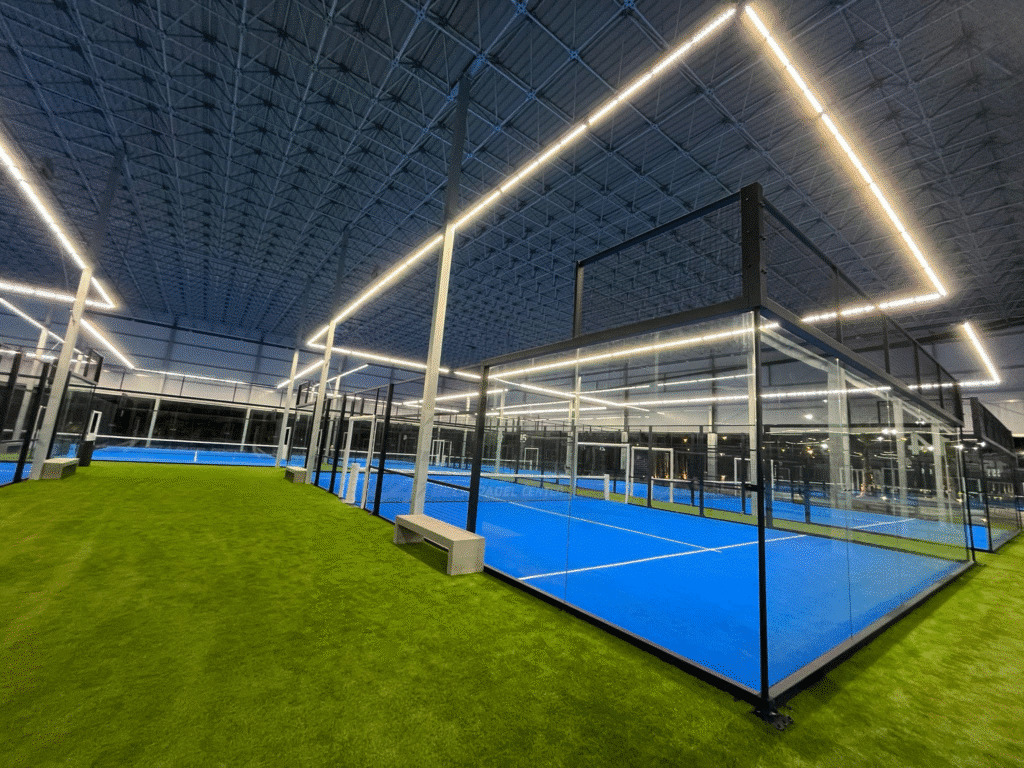
What is the Unified Glare Rating (UGR)?
This parameter is unknown to most people, yet it provides a great deal of very important information. It helps us choose lighting that better adapts to visual comfort in padel.
UGR indicates the level of glare produced by a light source in an enclosed space. To protect players’ visual health, this value typically ranges between 10 and 30, and is determined by the player’s position and their viewing direction (especially during lobs, which are constant in padel).
Cómo se calcula el UGR ?
To calculate this value, we can use the following equation:
UGR = 8 log {0.25 / Lb Σ L² ω / P²}
The factors that determine the UGR are: the light angle, the desired reflection and the luminance expressed in lumens.
- Lb is the background luminance perceived by the padel player or observer.
- ω is the angle subtended by the luminous part of the luminaire from the player’s point of view. This is why it is so important that the luminaire does not generate reflections on the glass walls of padel courts.
- P refers to the position index of each luminaire, individually, relative to the padel court.
As previously mentioned, UGR ranges between 10 and 30 for precision activities, and padel requires a high level of precision to follow the ball. A value of 10 represents lighting with excellent visual comfort for players, while values above 30 cause uncomfortable glare, are harmful to players’ visual health and are counterproductive for achieving high precision.
Average UGR values and their visual impact
UGR: implications according to glare level
What are the appropriate UGR values to achieve the best precision when playing padel?
These would be the average UGR values and their implications:
- UGR = 10 or less. This is the lowest value, where glare is imperceptible. The padel player enjoys the highest visual comfort and the best scenario in which their visual health is not affected by glare, loss of concentration or visual fatigue.
- UGR = 13. A value that is still very low, with glare that is barely perceptible for the padel player and offering great visual comfort.
- UGR = 16. This value is already perceptible and is used for visually precise tasks.
- UGR = 19. This is the average value and is therefore suitable for most tasks.
- UGR = 22. This value is already above what is acceptable, and is therefore used for moderate visual tasks where precision is not required.
- UGR = 25. This value is quite high, so it can be used for simple visual tasks, such as those typically found in heavy industry.
- UGR = 28 or higher. These are the highest values, which may appear in areas with very high lighting levels, such as lobbies or staircases, or in activities where precision is not required.
What are the most common pitfalls in lighting reports?
Unreliable DIALux studies
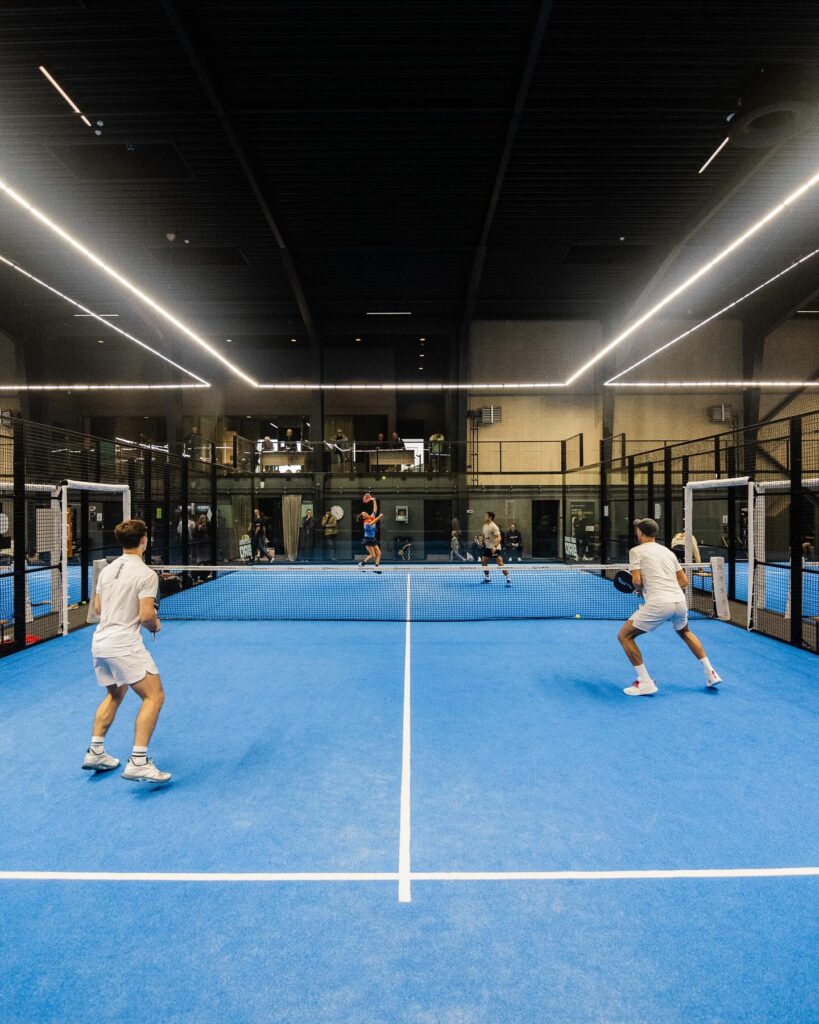
Reality is an unpleasant and painful surprise for clubs
Of the many DIALUX simulations sent to us by collaborators in the Padel sector, the vast majority "cheat."
- They provide diode efficiencies that don't match reality by any means. These are THEORETICAL efficiencies of the individual diode, in a laboratory, under optimal working conditions with laboratory power supplies.
- They provide reflection indexes for CEILINGS, WALLS, and even FLOORS that have nothing to do with padel or the reality of a court.
- They provide photometric distributions corresponding to lenses that the product they deliver does not actually have.
- They reference high-performance diode brands that are not actually included in the product.
- They provide energy consumption figures that are far from reality. The power supplies do not have an efficiency of 1-1, meaning 1W in does not result in 1W of light out.
- The power supplies (depending on model and brand) have efficiencies ranging from 0.8 to 0.94. This means that 100W with 80% efficiency actually consumes 120W.
- They perform the DIALUX simulations with measurements at incorrect levels or with parameters that are not covered by national and European regulations.
- Reflection indices for turf, glass, walls and ceilings that do not exist even in science fiction — yet hardly anyone knows how to detect them, and you end up being deceived without even realising it.
- They build DIALux studies to make them look good, even crudely editing the PDFs.

Is it important to have ENAC, UL and CSA certification? Does it guarantee the accuracy and reliability of the luminaire’s information?
The problem is that the end customer does not have the capacity or the technical knowledge to audit whether the data provided is real or has been manipulated to appear spectacular.
For this reason, it is advisable to request ENAC, TÜV or ILAC certificates, or certificates issued by an independent laboratory that validate the data provided on the performance and light distribution of the product that will ultimately be installed.
Not a “special” unit used for certification, only to then install a different one in its place.
Holding ENAC certification and accreditation for the luminaire guarantees 100% accuracy of the data (provided that a different product is not later supplied; in such a case, it would constitute fraud by the supplier, with the corresponding legal consequences).
Any DIALux study that has not been created using IES or LDT files generated by independent ENAC, TÜV or ILAC laboratories – accredited to carry out such tests – lack any kind of validity.
Failing to provide the original DIALux files (not just the PDF) so they can be reviewed, and to prevent the use of “marble floors, mirrored walls and glass ceilings with 50% reflectance to gain more light”, or taking measurements in places where they should not be taken because it is inconvenient to measure where required, etc., constitutes a fraudulent audit carried out with the intention of misleading by falsifying data.
UL and CSA laboratories audit us on a quarterly basis — both us as product manufacturers and each and every one of our suppliers — ensuring that all factories producing every component meet the highest quality standards and comply with all regulations.
It represents a significant financial cost and a major human effort, but it is worth it and demonstrates the company’s strong commitment to quality and reputation.
For this reason, it is advisable to request ENAC, TÜV or ILAC certificates, or certificates issued by an independent laboratory that validate the data provided on the performance and light distribution of the product that will ultimately be installed.
Not a “special” unit used for certification, only to then install a different one in its place.
Holding ENAC certification and accreditation for the luminaire guarantees 100% accuracy of the data (provided that a different product is not later supplied; in such a case, it would constitute fraud by the supplier, with the corresponding legal consequences).
Any DIALux study that has not been created using IES or LDT files generated by independent ENAC, TÜV or ILAC laboratories – accredited to carry out such tests – lack any kind of validity.
Failing to provide the original DIALux files (not just the PDF) so they can be reviewed, and to prevent the use of “marble floors, mirrored walls and glass ceilings with 50% reflectance to gain more light”, or taking measurements in places where they should not be taken because it is inconvenient to measure where required, etc., constitutes a fraudulent audit carried out with the intention of misleading by falsifying data.
UL and CSA laboratories audit us on a quarterly basis — both us as product manufacturers and each and every one of our suppliers — ensuring that all factories producing every component meet the highest quality standards and comply with all regulations.
It represents a significant financial cost and a major human effort, but it is worth it and demonstrates the company’s strong commitment to quality and reputation.
¿Quieres tener el mejor club y el más rentable ?
Ponte en contacto con nosotros, podemos ayudarte en muchos aspectos técnicos y tecnológicos para lograr tu objetivo.




Subscribe to our newsletter!
In our Newsletter, we tell you more about how we can help you. Subscribe to our newsletter and stay updated


Product
Resources
© 2026 Planet Power. All rights reserved.
Terms and Conditions of Sale | Privacy Policy | Cookie Policy | Legal Notice | More information about cookies
 Spanish
  English
  Italian
  French